- Home
- Homes
Cooling, moisture and ducts for Savannah houses
A long season, a lot of water in the air, and a good share of the plant either under the house or up in the attic. All three change what the right answer is.
No cooling
Diagnosed from the cheap end. The entries at the top fail most often here and cost the least.
Capacitor, contactor
The two cheapest parts on an outdoor unit and the two that fail most. A unit that hums but will not start is usually one of them, and it is a short visit.
A blocked coil
Pollen, grass and construction dust load a condenser fast here. It does not stop the unit, it quietly halves what it can do and raises the bill every hour it runs.
Condensate
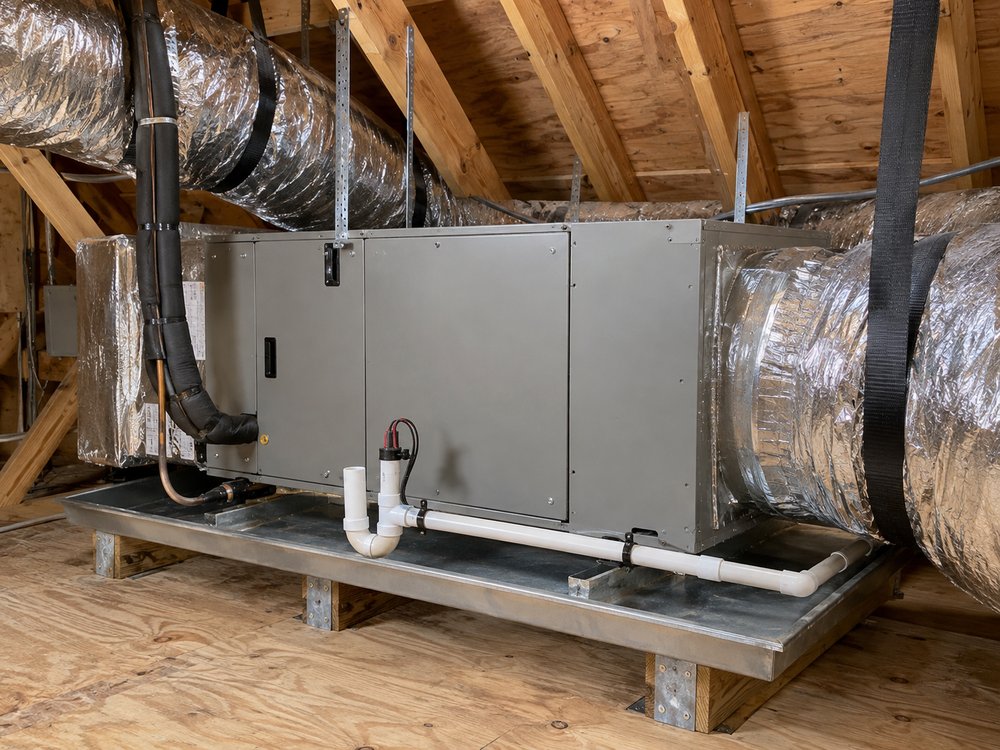
A blocked drain trips the safety switch and the system stops with nothing apparently wrong. In an attic air handler the alternative is a ceiling, which is why the switch is there.
Low charge
Measured, not topped up on sight. Refrigerant is not consumed — a system that wants more every year is leaking, and the leak is the job.
A frozen coil
Low airflow or low charge. Switch the cooling off, leave the fan running, and call. Running a compressor with a frozen coil is how compressors fail.
The thermostat
Batteries, wiring and settings. A share of summer call-outs genuinely end here and we say so rather than finding something else to charge for.
The moisture problem
The thing that actually distinguishes this climate, and the complaint most often answered with the wrong equipment.
Cool and clammy
An oversized system cools the air fast, satisfies the thermostat in minutes, shuts off, and never runs long enough to take moisture out. The house ends up cold and damp rather than comfortable.
This is the opposite of what almost everybody assumes, and it is why replacing a system with a bigger one usually makes the complaint worse.
Where the water actually comes from
- Duct leakage in the attic. Return-side leaks pull hot humid attic air straight into the system, every hour it runs. Sealing is cheap and it fixes the humidity and the bill together.
- A crawlspace under the house that is open to outside air on a coast. It is not our trade to close it, but it is frequently the source.
- Extract fans that terminate in the attic rather than outside — a mould problem being built one shower at a time.
- The condensate system itself, when a pan has rusted through or a trap has dried out.
What we will not do
We will not sell dehumidification as a fix for a system that is oversized, leaking or short-cycling. Where a house genuinely needs dedicated moisture removal we will say so and price it properly — but it is the fourth answer, not the first.
Ducts, heating and replacement
The room that never keeps up
Nearly always one of five things: a branch added during a remodel off a trunk with nothing spare; a flexible run crushed, kinked or run twice as long as it needed to be; a damper closed years ago; a return far too small for the rooms it serves; or leakage into the attic.
We measure static pressure and the airflow at that register, which turns an argument into two numbers on a page.
Heat pumps and auxiliary heat
Winters are short here but a heat pump running on auxiliary electric heat through them will keep the house warm and produce a bill nobody can explain. It is invisible unless somebody looks, and it is worth looking once.
Gas furnaces are combustion tested with an analyser and the readings written down, so the next visit has something to compare against.
What a replacement quote is built from
A room-by-room heat gain and heat loss calculation, the measured capacity of the existing ducts, the condensate route, and the electrical supply read off the plate of the proposed unit — not the rating on the old one.
Plus siting, which on this coast is a decision rather than a default. There is a whole page about that.
Gas, or a carbon monoxide alarm
Do not ring a contractor first. Get everybody out of the house and, from outside, call 911 and your gas utility’s emergency line. They arrive faster than any contractor, they do not charge you for a false alarm, and making the property safe is their job.
Ring us afterwards. Finding out why it happened is ours.